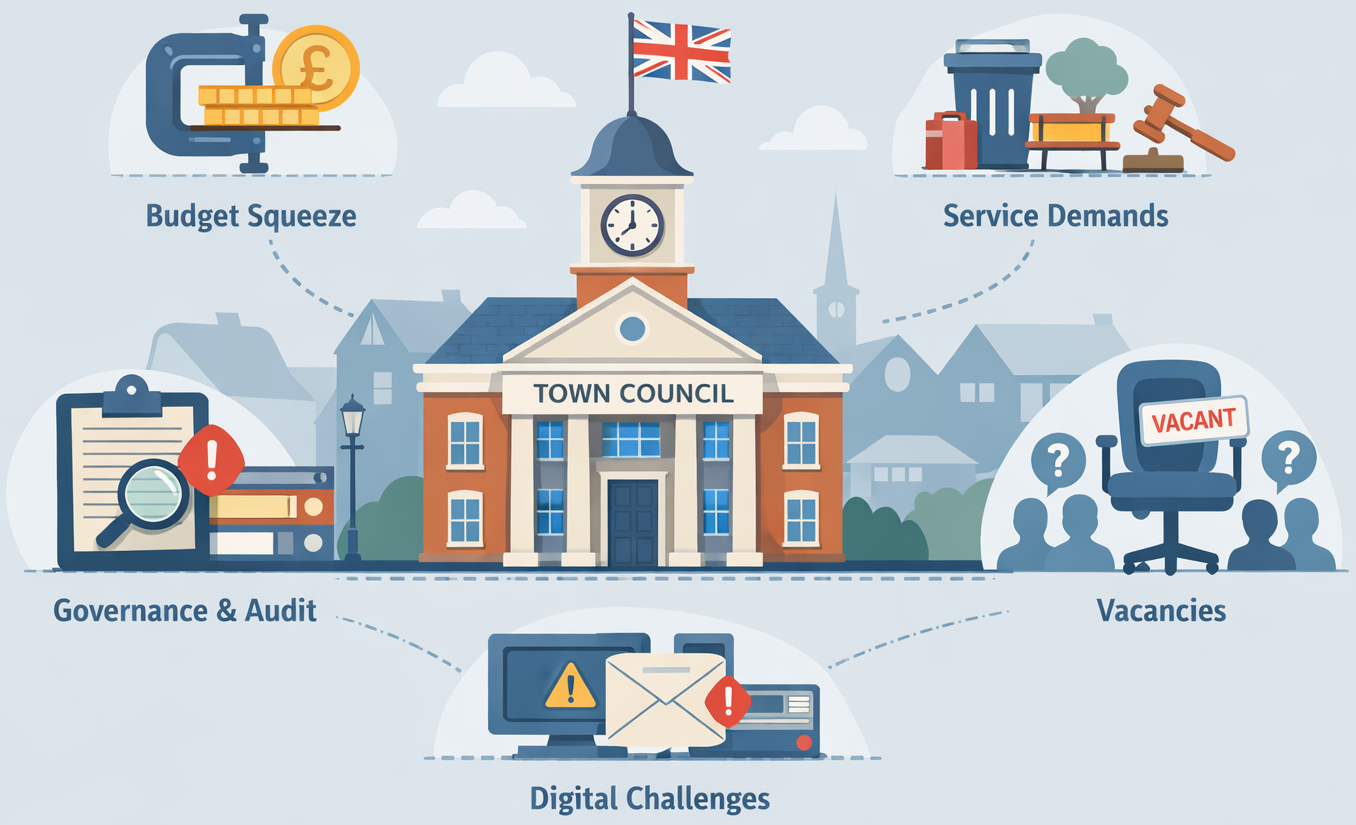
Few things concentrate a council like being told it is about to be abolished!
Since early 2025, county, district and borough councils across the country have been preparing for exactly that, as the Local Government Reorganisation (LGR) programme set out to merge many of them into larger unitary authorities by April 2028.
But in September 2026, LGR was paused in many areas. For digital transformation, that is an awkward mix. Procurement will grind to a halt at some councils as they monitor the situation, while procurement at other councils will be urgent as they are suddenly being expected to carry on as usual. Talk about Catch 22!
Why reorganise at all? What is wrong with the current system?
The programme began with the English Devolution White Paper in December 2024, and in February 2025 councils in 21 two-tier areas were invited to submit proposals. The case for LGR rested on four arguments:
- Less duplication. You only need one chief executive, one back-office, and one set of technology contracts.
- Simpler services. After all, it can be confusing if residents have to jump between different councils who deal with different things.
- Stronger councils. A single consolidated workforce is able to better organise in the face of social care and SEND pressures.
- Shared platforms. You are better off with 1-2 systems, rather than a broad patchwork of legacy solutions, websites and databases.
However, not everyone was convinced, with councils arguing over remote resident locations, transition costs, shared debts and pace. The technology case comes with a health warning too: when the LGA interviewed officers in 17 councils affected by reorganisation, it found many problems such as uneven digital maturity, gaps in councils’ understanding of their own technology, and real integration challenges and costs when in came to aligning systems.
So why did it all grind to a halt?
Lawyers, a change of leadership and (quite frankly) a very ambitious timetable.
The UK Government made decisions for four areas in March 2026 and a further 14 in July. Several councils pushed back, and Essex County Council sought a judicial review over the UK Government’s reasons, consultation, use of its own criteria and equality duties. On 7 September, citing updated legal advice, it withdrew the decisions for Essex, Hampshire, Norfolk and Suffolk. When Andy Burnham replaced the outgoing prime minister, the other 14 areas were also paused to check they aligned with the new administration’s priorities.
In any case, the 2028 deadline was always going to be a big ask. Anybody who works with local authorities can attest that change management is a slow burn!
Where does that leave councils that expected to be reorganised?
Many councils must now keep running indefinitely. Naturally, this has a big knock-on effect with everything they do. For example:
- Councils that expected to disappear in 2028 may have frozen recruitment and investment, and started consolidating IT with their neighbours. Now the goalposts have changed and they have to try and carry on like they did before. Hopefully not too many of them have allowed their current contracts to run down!
- Some councils will have no choice but to renew current licences, replace end-of-life software, or make security improvements that cannot wait. Other councils may end up doing nothing at all – after all, what if they spend money procuring a new platform that their successor rejects?
- Speaking of costs, a lot of money has already been spent on consultants, transition teams and business cases. Now more money will need to be spent as circumstances change, especially if LGR boundaries are altered. The £63 million capacity fund certainly helps, but underlying financial pressures remain.
- Experienced officers may have already accepted redundancy packages, taken retirement, or decided to move elsewhere. With LGR delays extending the status quo for the foreseeable future, that kind of human resource is hard to replace in the short-term.
- Just because there is a bit of uncertainty does not mean that contracts can be cancelled. In fact, current deals may end up transferring over to successor authorities later, so it’s important that both councils and suppliers understand expiry dates, licensing and what happens if authority boundaries change.
What should councils do in the meantime?
Our view is that large CRM replacements and wholesale consolidation will be deferred wherever the future authority is uncertain, while smaller, targeted projects accelerate. Councils that shelved CRM, Customer Portal, Asset or Waste Management projects in expectation of LGR now have a much stronger case for reviving them. After all, new unitaries (when they eventually arrive!) will end up inheriting duplicated systems regardless.
Where decisions have been withdrawn, the safest system investments are ones that stand on their own merits today and stay useful whatever happens next. Local authorities should look for systems that enable:
- measurable reductions in administration and manual processing
- short implementation programmes and modular, configurable delivery
- integration with the systems the council intends to keep
- clear data export, migration and exit arrangements
- contracts and licensing that can flex with reorganisation, subject to procurement law.
The LGA’s digital leadership through LGR is also well worth a look.
Conclusion
LGR gave councils a powerful reason to put off technology decisions, but many now face several more years on their current systems. The market is more complicated than a straightforward round of mergers. The investments that make sense are those justified independently of LGR that can be carried into whatever shape the future council takes.
That is where My Council Services fits. As a modular, no-code platform, it lets councils start with the services that need attention now, deliver in phases and add modules as their future becomes clearer, rather than staking everything on one large replacement programme.
The councils that act now to modernise their approach will be those best equipped to meet the challenges of the coming years.